
Instrument Engineering
Summary
The fourth and final Geostationary Operational Environmental Satellite (GOES) weather satellite has successfully launched at NASA’s Kennedy Space Center, Florida, on June 25, 2024, marking a significant milestone for weather forecasting and monitoring.
GOES-U, part of the GOES series designed and built by Lockheed Martin near Denver, Colorado, is the last in the lineup of GOES-R, GOES-S, and GOES-T, which are already in orbit providing vital, real-time weather data to forecasters across the United States.
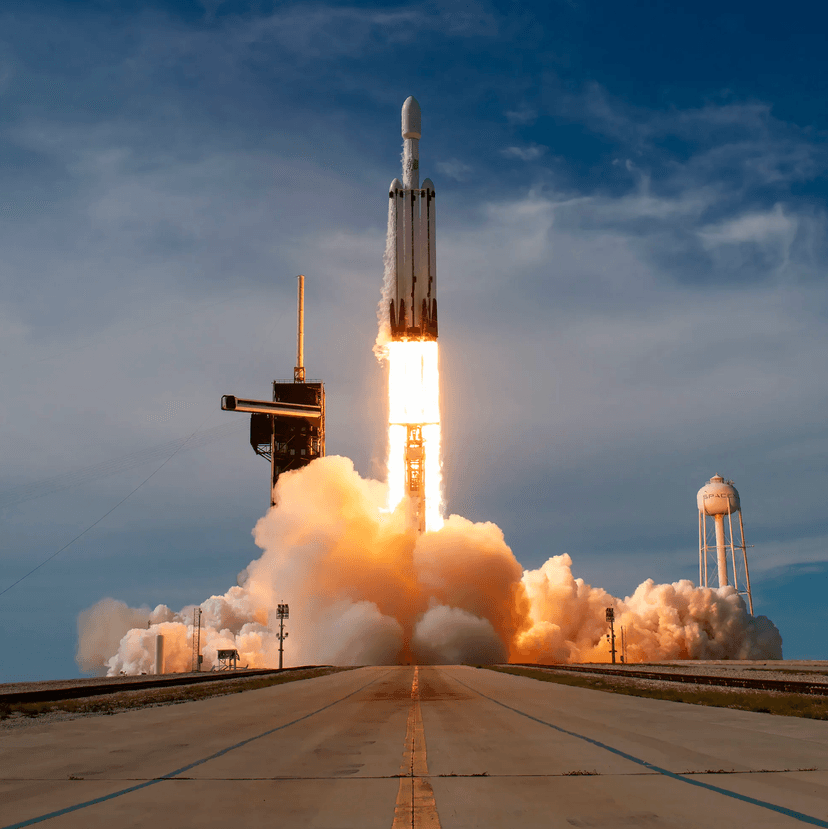
A SpaceX Falcon Heavy rocket carrying NOAA's GOES-U satellite lifts off from Launch Complex 39A at NASA’s Kennedy Space Center, Florida, on June 25, 2024.
Photo credit: SpaceX
SSAI's Ray McGlynn played a key role as the Integration and Test (I&T) Manager for the entire series, overseeing assembly and testing activities. Before the launch, the GOES-U spacecraft was delivered from Buckley Air Force Base in Colorado to the Astrotech launch processing facility in Florida in January 2024. SSAI’s Chris Smith, GOES-U Integration and Test Manager, accompanied the spacecraft aboard an Air Force C-5 Galaxy transport during its journey to Florida.
Earlier this year, in March 2024, the GOES-U underwent its Final Comprehensive Performance Tests (CPT), supported by several SSAI employees who served as subsystem leads:
Victor Lee – Communications Subsystem Lead
Mike Roza – Command and Data Handling Subsystem Lead
Joe Springer – Power Subsystem Lead
Following spacecraft testing, the GOES-U instruments were subjected to their final CPTs, with SSAI employees playing significant roles in the development and management of these instruments:
Kumar Tadikonda – EXIS, SUVI, SEISS, and CCOR Instrument Systems Engineer
Mike Grotenhuis – Magnetometer Instrument Manager
Ruth Cholvibul – GLM Instrument Systems Engineer
Chris Smith – EXIS and SUVI Instrument Manager
Marc Rafal – GLM Instrument Manager
The spacecraft, fueled with 3,600 pounds of hydrazine and 886 pounds of oxidizer, weighed in at an impressive 10,996 pounds at launch. After being encapsulated in its fairings, the spacecraft was moved to the SpaceX hangar at Kennedy Space Center in preparation for its journey into orbit.
Post-Launch Operations
Even after its successful launch, SSAI's involvement in the GOES Program remains crucial. As the GOES Deputy Mission Operations Manager, SSAI’s Mike Shallcross oversees orbit-raising activities, payload activation, and on-orbit Payload Testing (PLT) from NOAA’s Satellite Operations Facility (NSOF) in Suitland, Maryland. Mike previously served as the acting Mission Operations Manager for GOES-T’s PLT after its launch in March 2020.
SSAI is proud to continue supporting the GOES Program and contributing to the advancement of weather forecasting and environmental monitoring capabilities across the nation.